Money & Markets
When Money Dies
In 1923 Germans burned banknotes for heat because the notes were worth less than firewood. In 1946 Hungarian prices doubled every fifteen hours. In 2008 Zimbabwe printed a hundred-trillion-dollar bill that wouldn't buy a bus ticket. Same disease, three record holders.
1923, 1946, 2008 · Weimar, Hungary & Zimbabwe
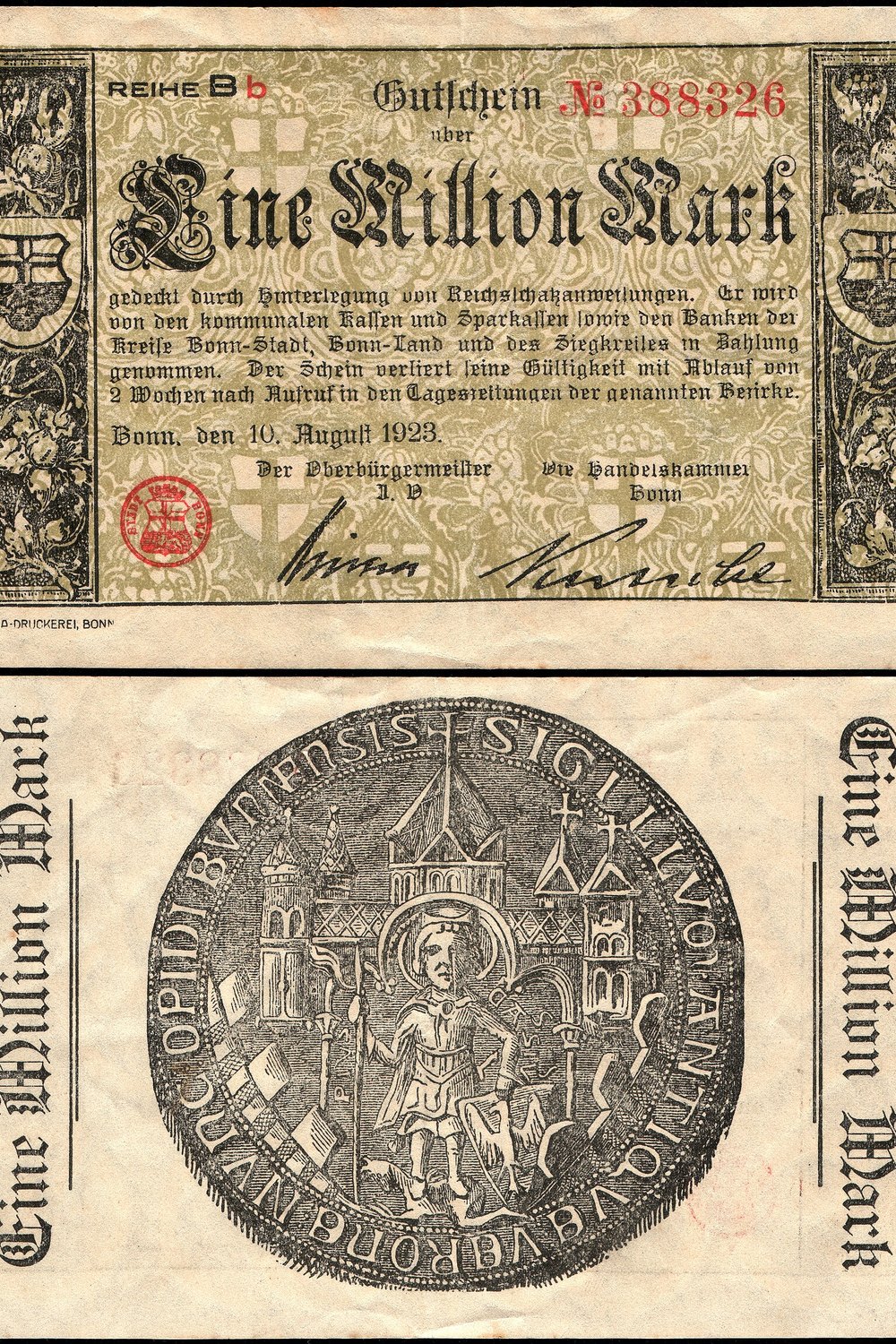
What actually happened
Hyperinflation is not big inflation. It's the death of the agreement that money stores anything. Weimar's version grew from reparations and the political choice to print rather than tax; by November 1923 a dollar bought 4.2 trillion marks and workers were paid twice daily so lunch wouldn't outrun wages.
Hungary 1946 remains the record: the pengő halved in value fast enough that the state issued the largest denomination note ever printed, 100 quintillion, and prices doubled roughly every 15 hours. Zimbabwe's 2008 run peaked, by IMF estimates, near 80 billion percent monthly, and the episode pins each number to its source.
All three ended the same way: a new unit, backed by something people could be made to believe. That is the entire secret of the old unit, admitted out loud.
The longer arc
Each collapse ended the same way, with a new currency stripped of the old one's printing habits. Germany's Rentenmark, introduced on November 15, 1923, was not backed by gold, which the state didn't have, but by mortgage claims on national land and industry, and Reichsbank commissioner Hjalmar Schacht enforced a hard ceiling on how many could be issued, refusing every government request to print more; the exchange rate was fixed at one trillion old marks to one Rentenmark.
Hungary's 1946 stabilization used roughly 30 tonnes of gold reserves, some of it recovered from wartime storage abroad, to back the new forint at a rate of 400 octillion pengő to one, alongside a full overhaul of the tax system and a temporary 100 percent bank reserve requirement. Zimbabwe took the blunter route in 2009, simply abandoning its own currency and letting the US dollar circulate freely, a fix that ended hyperinflation immediately but left the country without independent monetary policy, a tradeoff politically contested enough that Harare tried, and largely failed, to reintroduce a national currency a decade later.
The play to remember
The play.
Money is memory plus belief.
Governments can print the first; the second, once spent, doesn't reprint.
Was this interesting?
Select an option to vote. You can change it anytime.
Recommended for You
Friday the 13th, 1307
The Knights Templar ran Europe's first international bank: deposit in London, withdraw in Jerusalem by letter of credit. Their biggest debtor was the King of France. On a single Friday morning, he erased the debt by…
The Receipt
In 1519 the crown of the Holy Roman Empire went to auction between kings, and the winning bid came from a commoner. Four years later, with the emperor stalling on the debt, Jacob Fugger sent him what history remembers…
The Match King
By 1929 Ivar Kreuger controlled two-thirds of the world's match production and was lending sovereign nations more money than J.P. Morgan. A meaningful part of the collateral was $100 million of Italian government bonds…
The Locked Library
In the autumn of 1907, with banks failing and no central bank existing, one private citizen reportedly kept the heads of American finance in his library until dawn, until they pledged the money to stop the run. One of…
Newton's Madness
Isaac Newton sold his South Sea Company shares in April 1720 at a solid profit. Then he watched the bubble triple without him, bought back in near the top, and lost a fortune, around £20,000, a lifetime of income.
Tired of Fighting
Jesse Livermore shorted the 1929 crash and, by the widely reported figure, made around $100 million while the country broke. America blamed him for it. Eleven years later he died broke by his own hand, leaving a note…
Account 88888
A 28-year-old trader ran both Barings' Singapore trading desk and the back office that checked it. His hidden error account, 88888, swallowed losses for three years, until the 233-year-old bank that financed the…
No Millionaires at the Reunion
When Cornelius Vanderbilt died in 1877 he was worth more than the US Treasury held. In 1973, one hundred twenty of his descendants gathered for a family reunion, and by the family chronicler's account, not one of them…
The Bridge and the Bricks
In June 1982 the chairman of Italy's largest private bank was found hanging under Blackfriars Bridge in London, bricks and £10,000 in his pockets. Ruled suicide. Twenty years later the forensics were redone, the ruling…
New cases drop daily on  TikTok and
  Instagram. One case a day, one model you can retell.