Money & Markets
God and Profit
A medieval merchant headed his ledgers 'In the name of God and of profit' and threw away nothing: 150,000 letters, every contract, every insurance policy. Then his entire paper life disappeared into a stairwell of his own house for 460 years.
Prato, 1410 & 1870 · Francesco Datini
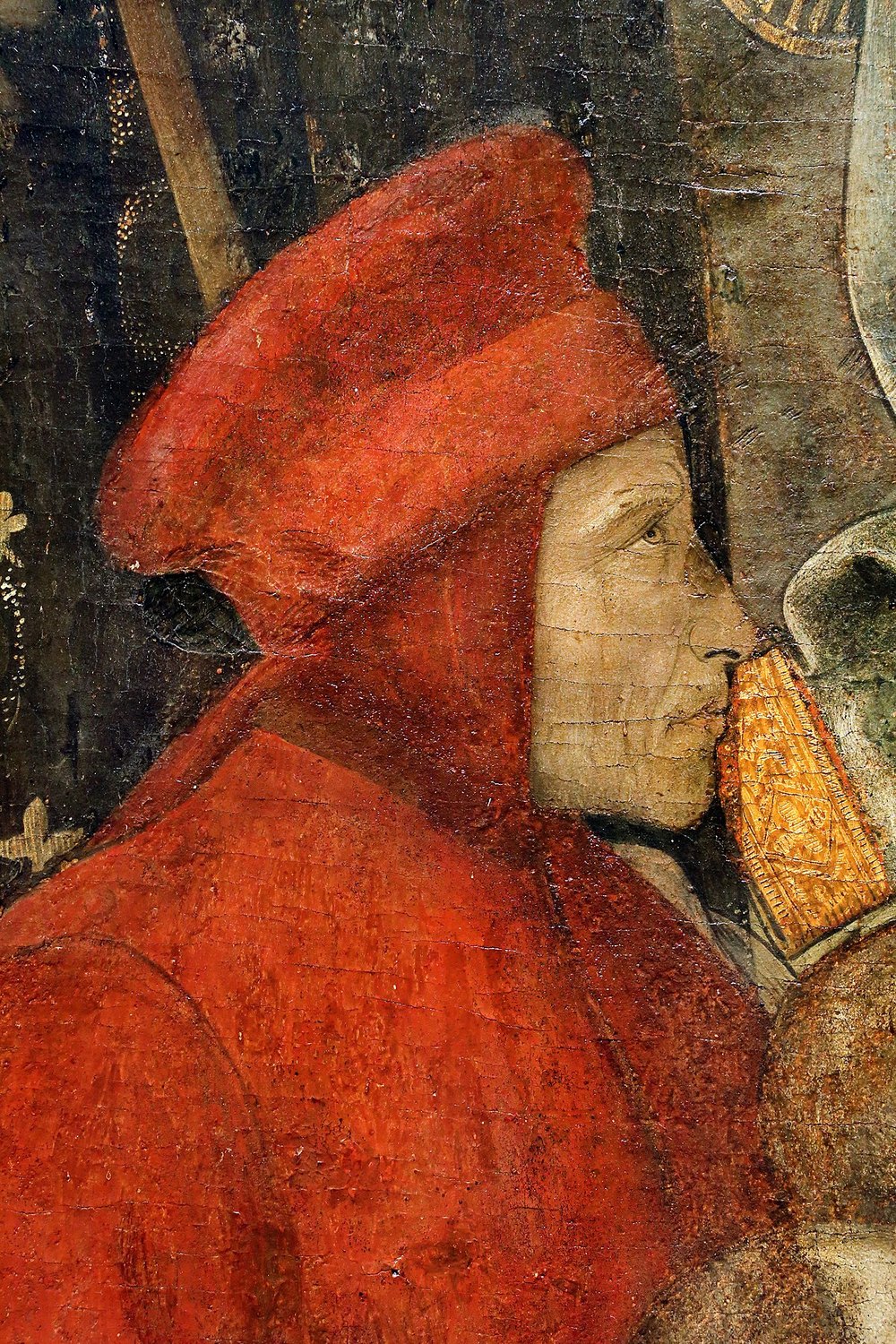
What actually happened
Francesco Datini ran a multinational before the word existed: branches from Avignon to Barcelona, wool, arms, banking, and the meticulous correspondence that managed it, including hundreds of letters to and from his wife Margherita, who learned to write to argue with him properly.
Dying heirless in 1410, he left his fortune to the poor of Prato and his papers to be preserved. Preservation meant sealed sacks that were eventually walled into a staircase and forgotten until workmen found them in 1870: the most complete medieval business archive ever recovered, and the source for modern knowledge of early insurance, exchange bills, and the invention rate of commercial life.
Iris Origo's The Merchant of Prato built the modern portrait; the motto's exact wording follows her transcription.
The longer arc
Datini's habit of keeping everything traces back to losing everything as a child: the Black Death of 1348 killed both his parents and three siblings in Prato, leaving him to a guardian's household with no inheritance to speak of. At fifteen he apprenticed to a Florentine merchant and by 1358 had joined a caravan of traders bound for Avignon, then the seat of the exiled papacy and a boomtown for anyone selling arms during the Hundred Years' War, which is where he made his first real money.
He spent 32 years building that Avignon trade before returning to Prato in 1382 to open branches that eventually stretched from Barcelona to Genoa, dealing in wool, arms, and eventually banking, and pioneering the modern practice of separately capitalized branch partnerships. He died heirless in 1410, leaving roughly 70,000 gold florins and his house to Prato's poor, along with the archive he had insisted on keeping. Workmen found the sealed sacks of papers behind a false wall in a staircase during 1870 renovations, giving historians the largest surviving cache of medieval business correspondence, later the basis for Iris Origo's 1957 biography.
The play to remember
The play.
Whoever keeps the records writes the history.
Datini bought immortality with filing discipline, and the profits were spent centuries ago.
Was this interesting?
Select an option to vote. You can change it anytime.
Recommended for You
Friday the 13th, 1307
The Knights Templar ran Europe's first international bank: deposit in London, withdraw in Jerusalem by letter of credit. Their biggest debtor was the King of France. On a single Friday morning, he erased the debt by…
The Receipt
In 1519 the crown of the Holy Roman Empire went to auction between kings, and the winning bid came from a commoner. Four years later, with the emperor stalling on the debt, Jacob Fugger sent him what history remembers…
The Match King
By 1929 Ivar Kreuger controlled two-thirds of the world's match production and was lending sovereign nations more money than J.P. Morgan. A meaningful part of the collateral was $100 million of Italian government bonds…
The Locked Library
In the autumn of 1907, with banks failing and no central bank existing, one private citizen reportedly kept the heads of American finance in his library until dawn, until they pledged the money to stop the run. One of…

Newton's Madness
Isaac Newton sold his South Sea Company shares in April 1720 at a solid profit. Then he watched the bubble triple without him, bought back in near the top, and lost a fortune, around £20,000, a lifetime of income.
Tired of Fighting
Jesse Livermore shorted the 1929 crash and, by the widely reported figure, made around $100 million while the country broke. America blamed him for it. Eleven years later he died broke by his own hand, leaving a note…
Account 88888
A 28-year-old trader ran both Barings' Singapore trading desk and the back office that checked it. His hidden error account, 88888, swallowed losses for three years, until the 233-year-old bank that financed the…
No Millionaires at the Reunion
When Cornelius Vanderbilt died in 1877 he was worth more than the US Treasury held. In 1973, one hundred twenty of his descendants gathered for a family reunion, and by the family chronicler's account, not one of them…
The Bridge and the Bricks
In June 1982 the chairman of Italy's largest private bank was found hanging under Blackfriars Bridge in London, bricks and £10,000 in his pockets. Ruled suicide. Twenty years later the forensics were redone, the ruling…
New cases drop daily on  TikTok and
  Instagram. One case a day, one model you can retell.