Empire Decisions
The Night FTX Vanished
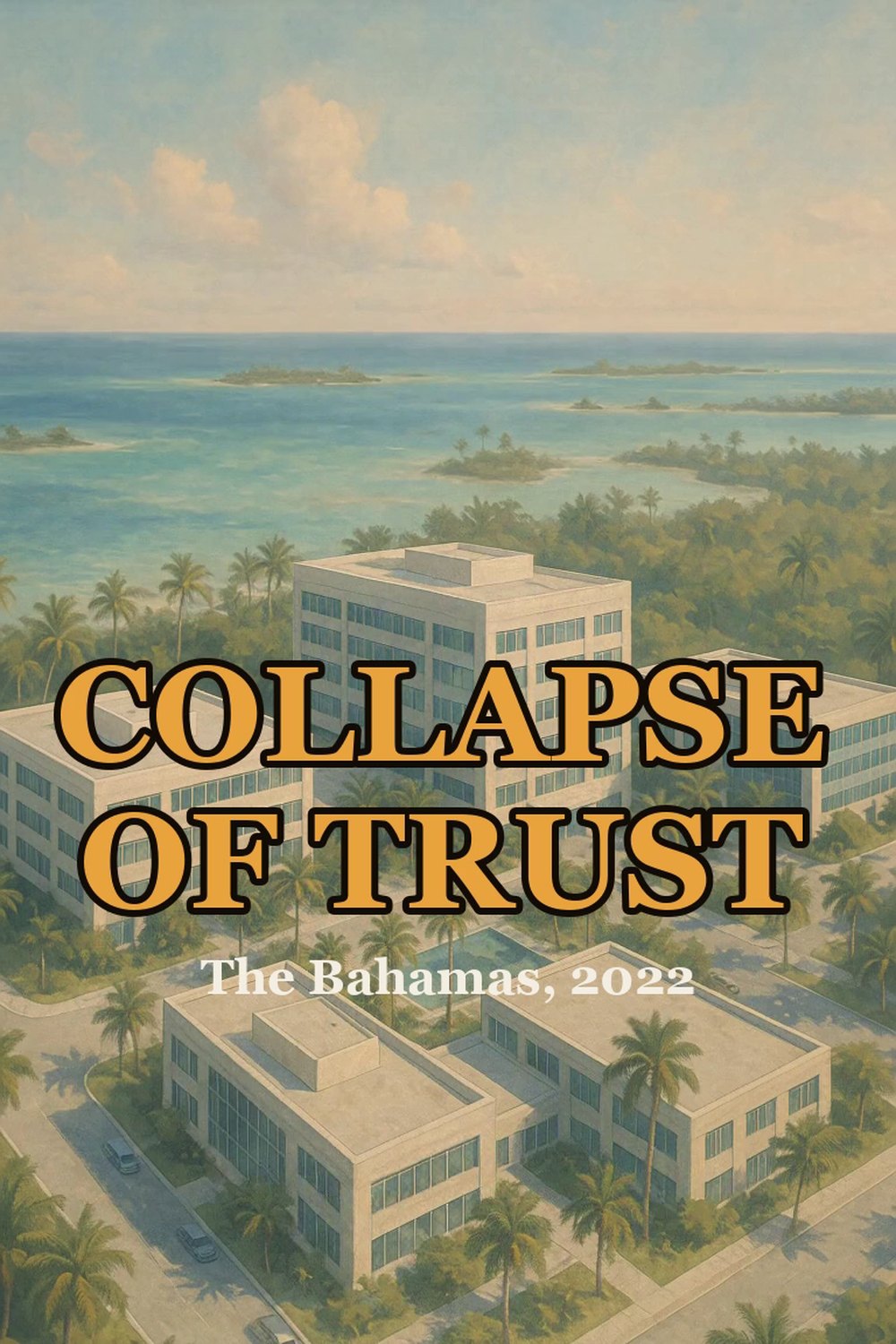
On November 2, 2022 a leaked balance sheet showed FTX's sister fund was built on FTX's own token. Nine days later the exchange, its $32 billion valuation, and roughly $8 billion of customer money were gone.
The Bahamas, 2022 · Sam Bankman-Fried
What actually happened
The CoinDesk story revealed Alameda Research's assets were dominated by FTT, the token FTX itself issued. When rival exchange Binance announced it would dump its FTT holdings, the token's price collapsed, and with it the collateral propping up loans that had quietly been funded with customer deposits.
A run followed; withdrawals froze; a rescue acquisition by Binance died in a day of due diligence. FTX filed for bankruptcy on November 11. Bankman-Fried was convicted on seven fraud counts a year later. The industry's most trusted exchange had been prestige all the way down: congressional testimony, stadium naming rights, celebrity endorsements.
The customer money largely resurfaced through the bankruptcy estate's asset sales, but the exchange's legend didn't survive: the trust was the product, and it never trades again.
The longer arc
Sentencing came in March 2024: 25 years, roughly half of what prosecutors had asked for but still among the longest terms ever handed to a white-collar defendant. Caroline Ellison, the former Alameda Research CEO and Bankman-Fried's on-and-off girlfriend, and Gary Wang, FTX's co-founder, had both pleaded guilty earlier and testified against him for lighter sentences, becoming the government's central witnesses on how the fraud actually worked. Ellison, whose seven fabricated spreadsheets became a key trial exhibit, was sentenced to two years. Wang, credited with helping prosecutors trace the missing funds, got no additional prison time at all.
The bankruptcy estate later recovered enough, largely by selling FTX's remaining crypto and startup stakes as prices rebounded, to repay creditors based on the dollar value of their claims at the time of the November 2022 collapse. That produced headlines claiming customers were being made whole, even paid back with interest. The sentencing judge pushed back on that framing directly, calling the full-repayment claim misleading and logically flawed, since anyone who had kept holding crypto instead of a frozen claim would have made far more money over that same period.
The play to remember
The play.
Prestige laundering: when the audit is replaced by endorsements, the balance sheet is whatever the leak says it is.
Was this interesting?
Select an option to vote. You can change it anytime.
Recommended for You

The Board That Fired Its Founder
In 1985 Apple's board sided with the professional CEO Steve Jobs had personally recruited, and stripped Jobs of all operating power. Twelve years later the company was ninety days from insolvency. The only option left…
The Quarter Enron Ran Out of Room
Enron's numbers worked for years because the losses lived in entities nobody consolidated and the profits were booked the day a deal was signed. In the autumn of 2001, one analyst finally asked the question that ran out…

The PayPal Decision
Confinity and X.com were burning millions a month trying to destroy each other in the same building on University Avenue. The decision that created PayPal, and the mafia of founders who built Tesla, LinkedIn, YouTube…
Musk's Christmas Eve
In the same week of December 2008, SpaceX was one failed launch from dead and Tesla was hours from missing payroll. The funding that saved both closed on Christmas Eve, after three straight rocket failures and a divorce…
The Man Who Sold the Eiffel Tower: Twice
In 1925 Paris couldn't afford to maintain its own monument. Victor Lustig read one newspaper article about it, printed fake government stationery, and sold the Eiffel Tower for scrap to a buyer too embarrassed to report…

The Ledger That Caught Capone
Al Capone ordered murders in daylight and never saw the inside of a courtroom for any of them. What finally convicted him was arithmetic: a seized ledger and the tax owed on money he officially never earned.
The Money Box
Lustig sold a mahogany box that 'printed' hundred-dollar bills for up to $46,000 a box. The machine worked perfectly for exactly two bills, both real, both loaded by Lustig before the demonstration.
The Ransom Room
A room 22 feet by 17, filled with gold as high as a man could reach. That was the price the Inca emperor offered for his life. The Spaniards took delivery of roughly six tons of gold, then convened a trial in a language…

The Blind Doge
An army of crusaders arrived in Venice 34,000 silver marks short of their shipping bill. The city's doge, blind and by the chronicles around ninety, turned their debt into a repossession of his business rivals, and the…
New cases drop daily on  TikTok and
  Instagram. One case a day, one model you can retell.